


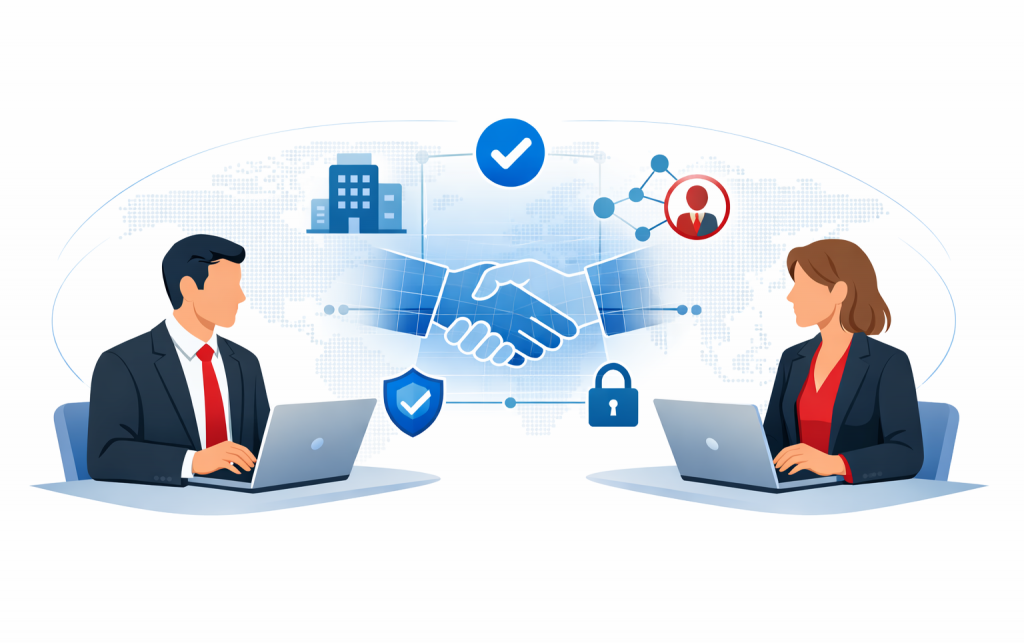
Business used to happen with a handshake. You would meet a partner for lunch, look them in the eye, and sign a contract on the spot. But the world has changed. Today, companies work with partners, suppliers, and vendors they may never meet in person. While this opens up a global market, it brings a big question with it: How do you know a business is who they say they are?
This process is called Know Your Business, or KYB. When everything happens remotely, checking a business’s background becomes harder, but it is also more important than ever to prevent fraud and money laundering.
What are the Common Challenges of Remote KYB?
Verifying a business online is not as simple as checking a driver’s license. Companies are complex, and bad actors are getting smarter. Here are the biggest hurdles companies face when trying to verify a business remotely.
Finding the Real Owners
The hardest part of KYB is often identifying the “Ultimate Beneficial Owner” (UBO). This is the actual human being who benefits from the company. Criminals love to hide behind layers of shell companies. They might have Company A owned by Company B, which is owned by a trust in a different country. Unravelling this web without a face-to-face meeting or physical paperwork can be a nightmare.
Fake Documents
In a digital world, forgery is easier. It takes just a few minutes for a fraudster to Photoshop a bank statement or a certificate of incorporation. When you are reviewing a PDF uploaded to a portal instead of holding a physical paper document, it is much harder to spot the fakes.
Different Rules for Different Places
If you are doing business globally, you have to follow global rules. The laws for verifying a business in the U.K. are different from those in Singapore or Brazil. Keeping up with these changing regulations is a full-time job. If you get it wrong, you could face heavy fines.
Slowing Down Business
Nobody likes paperwork. If your verification process takes two weeks and requires the client to upload 50 different documents, they might just give up and go to a competitor. The challenge is balancing strong security with a smooth, fast experience for the user.
Best Practices in Remote KYB Onboarding
So, how do you verify a business safely without scaring them away? Here are some best practices that modern companies use.
Automate Where You Can
Relying on humans to manually check every document is slow and prone to error. Smart companies use automated tools that can check global business registries in seconds. These tools can instantly pull data from government databases to see if a company number is valid and if the business is active.
Use Real-Time Data
Do not rely on old static databases. A company might have been safe six months ago but could be bankrupt or under sanctions today. Best practice involves connecting to “live” data sources that give you the current status of a company right now, not what it looked like last year.
The “Risk-Based” Approach
Not every business needs the same level of scrutiny. A small local bakery opening a merchant account probably does not need the same deep investigation as a massive international crypto exchange. By categorising businesses by risk level, you can speed up the process for the low-risk ones and focus your energy on the high-risk ones.
Liveness Checks
Since you cannot meet the business owner in person, use technology to bridge the gap. “Liveness” checks require the person on the other end to perform a specific action on camera like blinking or turning their head to prove they are a real human and not a static photo or a deepfake video.
Continuous Monitoring
KYB should not stop once the contract is signed. Ownership structures change, and businesses can land on sanctions lists overnight. Continuous monitoring means your system keeps an eye on your partners and alerts you if something suspicious changes later on.
Conclusion
Remote KYB is a necessary part of doing business in the digital age. While it comes with challenges like hidden owners and sophisticated fraud, technology is catching up.
The goal is not just to tick a regulatory box. It is to build a circle of trust. By using automation, staying updated with real-time data, and treating verification as an ongoing process, companies can protect themselves without slowing down their growth. In a world where we might never shake hands, these digital handshakes are what keep the global economy moving safely.
How Can Trustnet.Trade Help
Trustnet.Trade helps you close critical sanctions compliance gaps by going far beyond basic name screening. With instant KYB and UBO checks, real-time monitoring, and global sanctions screening including AMS and PEP, Trustnet.Trade helps you identify indirect ownership risks. Its automated alerts, visual ownership mapping, and compliance widgets give you continuous monitoring and transparency. Combined with risk-based questionnaires, and whistleblower modules, it keeps companies of any size up to date with evolving regulations, preventing reputational and financial risks from escalating into significant problems.